
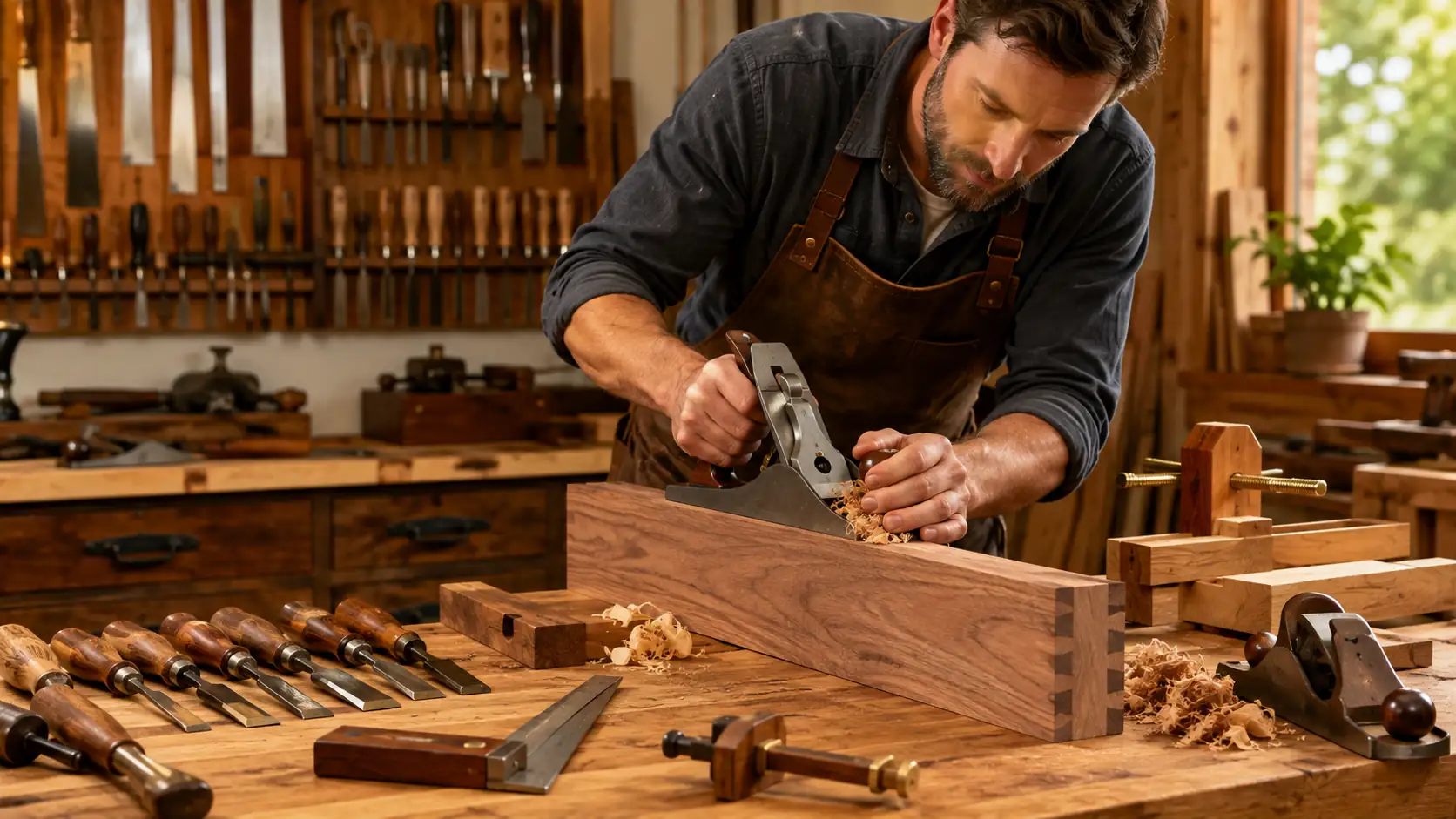
Mastering woodworking hand tools means producing accurate, repeatable results with controlled manual techniques.
The best woodworking hand tool tips follow one process: select, prepare, secure, mark, work, verify, correct, and maintain.
The U.S. Bureau of Labor Statistics counted 199,920 woodworkers in May 2025. This is a workforce figure, not a measure of hand-tool use.
Key Woodworking Hand Tool Definitions
A woodworking hand tool is a non-powered tool operated by hand to measure, cut, shape, trim, assemble, or finish wood.
Hand-tool mastery is the ability to achieve a planned result with accuracy, control, repeatability, and safe technique.
Workholding is the method used to keep a workpiece stable with a vise, clamp, bench stop, or similar device.
A reference face is the chosen surface from which related measurements and layout marks are taken.
A kerf is the slot or width of material removed by a saw blade during a cut.
Tear-out is unwanted lifting or breaking of wood fibers ahead of a cutting edge.
Honing is the refinement of a sharpened cutting edge to improve cutting performance.
Repeatability is the ability to produce the same dimension, fit, or surface quality across repeated operations.
Choose the Right Hand Tool for Each Woodworking Task
- Measuring and marking: rules, squares, gauges, and marking knives establish references.
- Cutting: hand saws separate stock and create joinery cuts.
- Shaping: chisels and hand planes remove material progressively.
- Trimming: edge trimmers and scrapers refine applied edging.
- Assembly: mallets, clamps, and gluing tools support fitting and bonding.
- Sharpening: stones and guides restore cutting edges.
Prepare Your Tools and Workpiece
Check Tool Condition and Sharpness
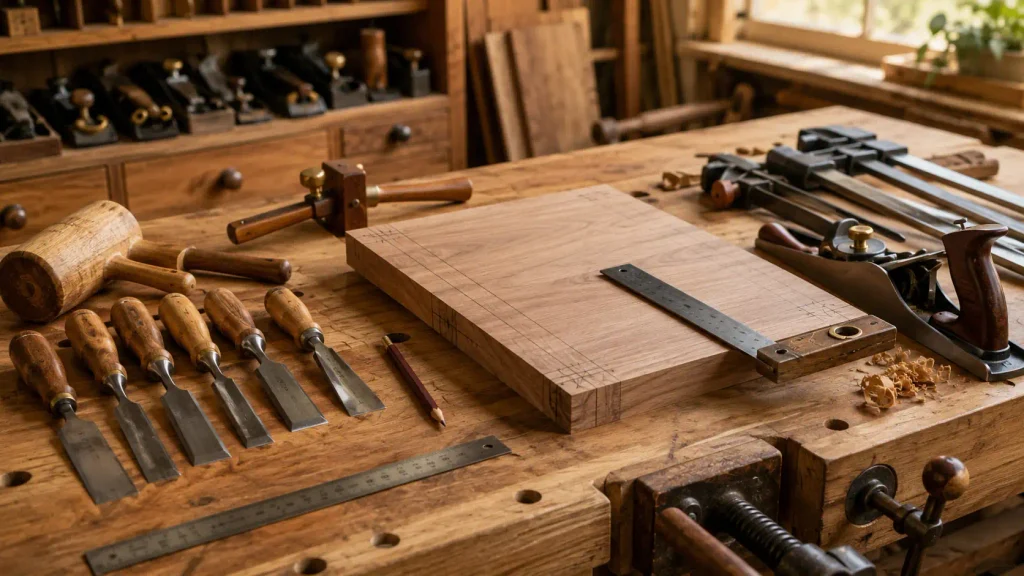
Inspect edges, handles, fasteners, and adjustments before use. OSHA requires workplace hand tools to be maintained in safe condition.
A dull or damaged edge can increase force and reduce control. Sharpen or repair the tool when its condition is unsuitable.
Secure the Workpiece
Use a vise, clamp, bench stop, or suitable fixture. Stable workholding helps the tool follow the intended line predictably.
Establish References and Read the Grain
Choose a reference face and edge, then measure related dimensions from them. This reduces cumulative layout errors.
Check grain direction before planing, paring, or scraping. Working with the grain often reduces tear-out when the operation allows it.
Use a Repeatable Step-by-Step Hand Tool Method
- 1. Define: identify the required dimension, joint, surface, or edge.
- 2. Select: match the tool to the task and material.
- 3. Inspect: check condition, sharpness, and adjustment.
- 4. Secure: stabilize the workpiece.
- 5. Mark: establish a clear reference.
- 6. Work: remove material progressively.
- 7. Verify: check straightness, squareness, flatness, fit, or finish.
- 8. Correct: fix small deviations early.
- 9. Maintain: clean, sharpen, protect, and store the tool.
Master Core Woodworking Hand Tool Techniques
Measure and Mark Before Cutting
Use the same reference face for related measurements. Keep the first cut on the waste side when appropriate, then refine toward the line.
Saw With Less Drift
Start with light strokes to establish the kerf. Align the saw with the layout line and let the teeth cut instead of forcing the blade.
If the saw drifts, reduce pressure and correct gradually rather than twisting the blade.
Use Chisels With Greater Control
Remove waste in stages and approach the final line progressively. Secure the work and keep hands outside the cutting path.
Plane and Scrape With Better Surface Control
Take lighter passes near the target surface. If fibers tear, check grain direction, cutting depth, setup, and edge condition.
Trim and Finish Edges Precisely
Edge banding is a strip applied to a panel edge to cover, protect, or finish the exposed core.
The Virutex AU93 trims both sides of edge banding up to 0.6 mm thick and 40 mm wide. Its scraper also removes glue residue and burrs.
The Virutex RC21E is designed for end trimming of PVC, melamine, polyester, veneer, and similar edge materials.
- Trim the long sides.
- Cut the ends.
- Inspect the transition.
- Scrape remaining residue.
Apply Glue and Assemble With Control
Apply adhesive evenly and follow its requirements for coverage, pressure, open time, and curing.
The Virutex EM25D hand gluer uses a 122 mm lower roller for vinyl glue and includes a trigger shut-off.
Keep Cutting Edges Sharp
Sharpening is the process of restoring the geometry of a cutting edge.
Honing is the process of refining that sharpened edge to improve cutting quality and control.
No single bevel angle is correct for every chisel or plane iron. Use the intended geometry and manufacturer guidance when available.
Use Hand Tools Safely and Ergonomically
Ergonomic hand-tool use means reducing unnecessary force, repetition, and awkward body positions while maintaining control.
NIOSH recommends selecting non-powered hand tools that reduce excessive force and awkward positioning.
- Secure the workpiece.
- Keep the cutting path clear.
- Keep hands outside the likely tool path.
- Repair or replace damaged tools.
- Change the setup if excessive force is required.
- Use PPE appropriate to the hazard.
Common Woodworking Hand Tool Problems and Fixes
- Saw cut drifts: check kerf, alignment, pressure, and workholding.
- Chisel tears fibers: take smaller cuts and check sharpness and grain direction.
- Plane causes tear-out: reduce cutting depth and reassess edge condition and grain.
- Edge is not flush: return to a reliable reference and remove less material.
- Too much force is needed: check tool choice, sharpness, angle, grain, and workholding.
Practice Hand Tool Skills With Measurable Goals
Deliberate practice is focused repetition with a defined objective, measurable result, and correction after each attempt.
- Make repeated square cuts.
- Pare to a marked line.
- Plane a face and check flatness.
- Trim identical edges.
- Track how much correction each attempt needs.
Judge progress by accuracy, repeatability, surface quality, fit, and reduced correction rather than speed alone.
There is no universal woodworking tolerance. Acceptable deviation depends on the joint, material, size, finish, and project specification.
When Should You Use Hand Tools Instead of Power Tools?
- Hand tools: fine fitting, small corrections, portable work, and controlled finishing.
- Power tools: heavy material removal, production speed, and repeated machining.
- Combined workflow: power tools for rough sizing and hand tools for final fit or finish.
Frequently Asked Questions About Woodworking Hand Tools (FAQs)
A hand tool needs sharpening when it requires more force, leaves a rough surface, crushes fibers, or no longer cuts predictably.
Straight-grained, uniform wood is usually easier for beginners because its cutting behavior is more predictable.
Woodworking hand tools should be stored clean and dry, with sharp edges protected and away from damp conditions that can cause corrosion.
Yes. Dense hardwood may require sharper cutting edges, lighter cuts, and more secure workholding.
Neither is universally better. Japanese saws usually cut on the pull stroke, while many Western saws cut on the push stroke.
A simple box, shelf, or practice board is a good first project because it teaches measuring, marking, sawing, planing, and fitting.
No. Good results also depend on tool setup, sharpness, workholding, technique, and consistent measurement.
Yes for many operations, but a combined workflow is often more efficient for heavy stock removal or repeated machining.
Build a Repeatable Hand Tool Process
The best woodworking hand tool tips work as one system: choose, inspect, secure, mark, work, verify, correct, and maintain.
Accuracy comes first. Repeatability comes next. Efficiency improves as the same process produces reliable results with less correction.
Virutex supports this workflow with specialized manual tools for trimming, scraping, gluing, and edge finishing.


