
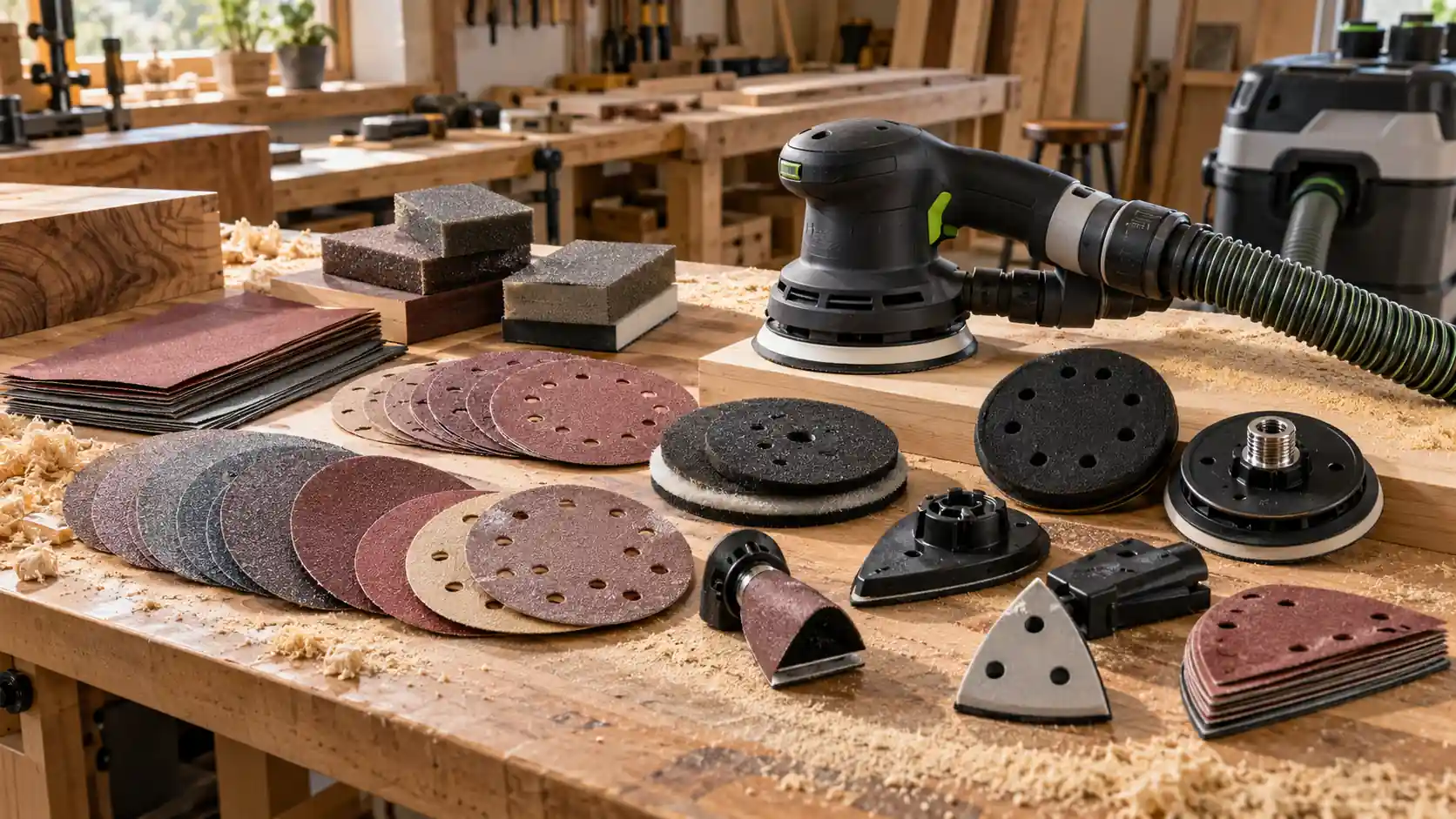
Sander accessories are components and consumables that improve sanding, dust control, surface finishing, or machine compatibility.
The right sander accessories for woodworking help control material removal, scratch patterns, dust extraction, surface quality, and tool performance.
A complete sanding setup normally combines the sander, abrasive, backing system, dust control, and accessories required for the specific surface.
What Are Sander Accessories?
A sander accessory is any compatible component or consumable used to support, modify, maintain, or improve a sanding operation.
Common examples include sanding discs, sheets, belts, backing pads, interface pads, dust extraction components, sanding blocks, brushes, and abrasive rollers.
Essential Sanding Terms for Woodworkers
An abrasive is a material containing hard particles that remove or refine another material through friction.
Abrasive grit is the particle-size classification used to describe how coarse or fine a sanding abrasive is.
A sanding disc is a circular abrasive designed for use with a compatible disc or orbital sander.
A sanding sheet is a flat abrasive sheet used with orbital sanders, finishing sanders, or manual sanding blocks.
A sanding belt is a continuous abrasive loop designed for belt sanders and rapid material removal.
A backing pad is the support surface between a sander and its abrasive disc or sheet.
An interface pad is a flexible layer placed between the backing pad and abrasive to increase surface conformity.
Dust extraction is the process of capturing sanding dust close to the point where it is generated.
A sanding block is a hand-held support that keeps abrasive paper stable during manual sanding.
Abrasive loading is the accumulation of dust and removed material between abrasive particles.
Hook-and-loop fastening is a reusable system for attaching compatible abrasives to a sanding pad.
Grit progression is the planned movement from coarser abrasives to finer abrasives during surface preparation.
1. Sanding Discs, Sheets, and Belts
Abrasives perform the primary cutting action during sanding. Their format must match the machine, surface, and required removal rate.
- Sanding discs: suited to compatible rotary and random-orbit sanders.
- Sanding sheets: used with orbital and finishing sanders.
- Sanding belts: designed for fast stock removal with belt sanders.
- Abrasive rollers: used with compatible machines for larger or specialized surfaces.
How to Choose the Right Sandpaper Grit
Sandpaper grit determines the size of the abrasive particles and influences how aggressively material is removed.
- P40–P60: aggressive stock removal or stripping.
- P80–P120: general leveling and intermediate sanding.
- P150–P180: refinement before many finishing processes.
- P220 and above: fine sanding when required by the material or coating system.
These ranges are general guidelines. The correct grit depends on the wood, previous scratch pattern, surface condition, and final finish.
2. Backing Pads for Orbital and Rotary Sanders
A backing pad supports the abrasive and transfers the sander’s movement to the workpiece.
Pad firmness influences pressure distribution, material removal, and how closely the abrasive follows the surface.
- Firm backing pads: provide stronger support for flatter surfaces.
- Soft backing pads: conform more easily to slight curves and profiles.
- Hook-and-loop pads: allow fast abrasive replacement when compatible.
Inspect backing pads regularly. Worn, damaged, or distorted pads can reduce sanding consistency.
3. Interface Pads for Curved and Profiled Surfaces
An interface pad is a flexible intermediate pad that helps an abrasive adapt to curves, contours, and sensitive surfaces.
Interface pads are useful when a rigid backing system applies excessive pressure to a small contact area.
- Rounded furniture components.
- Curved panels.
- Profiles and moldings.
- Edge transitions.
- Fine surface finishing.
Greater flexibility can reduce sanding aggressiveness. Select the interface according to the required finish and surface geometry.
4. Dust Collection Accessories
Wood dust is particulate material produced when wood is cut, machined, or sanded.
A dust collection accessory is a component that helps transport sanding dust from the machine to a bag, container, or extractor.
Effective dust control improves workspace cleanliness and can reduce abrasive loading.
- Use integrated dust collection when available.
- Connect a compatible extractor when supported.
- Keep extraction ports clear.
- Check hoses for restrictions.
- Align abrasive holes with pad extraction holes.
- Empty dust collection equipment when required.
Why Dust Extraction Matters During Sanding
Dust extraction helps remove particles close to their source instead of allowing them to accumulate around the sanding area.
It can also improve visibility and help the abrasive continue cutting efficiently.
5. Sanding Blocks for Manual Touch-Ups
A sanding block is a rigid or flexible support used to hold sandpaper during controlled manual sanding.
Manual sanding is useful where powered equipment cannot reach or where localized control is required.
- Inside corners.
- Narrow edges.
- Small components.
- Profiles.
- Final touch-ups.
- Areas near delicate details.
Match the block shape to the workpiece. A flat block should not be forced onto a curved profile.
6. Brushes and Abrasive Rollers
A brush sanding accessory is a rotating brush used to clean, texture, age, polish, or refine compatible surfaces.
An abrasive roller is a cylindrical sanding accessory designed for compatible machines and specialized surface preparation.
- Nylon brushes: useful for compatible wood-aging and polishing applications.
- Metal brushes: useful for selected cleaning, aging, rust-removal, or deburring tasks.
- Abrasive rollers: suitable for sanding and surface preparation on compatible equipment.
Always verify material suitability, accessory dimensions, approved operating speed, and machine compatibility.
7. Hole-Matched Abrasives for Better Dust Extraction
A hole-matched abrasive is a sanding disc or sheet whose extraction holes align with the holes in the backing pad.
Correct alignment allows airflow to move through the abrasive and into the extraction system.
- Check abrasive dimensions.
- Check hole pattern.
- Confirm attachment type.
- Match the backing pad.
- Inspect extraction openings.
How to Match Sander Accessories to Your Machine
Accessory compatibility is the ability of an accessory to fit and operate correctly with a specific sanding machine.
Compatibility must be checked before installation. Similar-looking sanding accessories are not necessarily interchangeable.
- Orbital sander: check sheet size, pad dimensions, attachment, and extraction pattern.
- Random-orbit sander: check disc diameter, backing pad, and hole pattern.
- Belt sander: check belt width, length, and abrasive specification.
- Brush sander: verify roller or brush dimensions and approved use.
How to Build a Professional Sanding System
A sanding system is the combination of machine, abrasive, backing, dust extraction, and technique used to prepare a surface.
- 1. Define the task: stripping, leveling, smoothing, finishing, or polishing.
- 2. Choose the machine: match the sander to the surface and removal rate.
- 3. Choose the abrasive: select the correct format and grit.
- 4. Check the pad: confirm condition and firmness.
- 5. Connect dust extraction: use the available system correctly.
- 6. Test the setup: use scrap material when practical.
- 7. Progress through grits: remove the previous scratch pattern.
- 8. Inspect the surface: check the result before finishing.
How to Use Grit Progression Correctly
Grit progression is the sequence used to replace deeper sanding scratches with progressively finer ones.
- Start with the least aggressive grit that performs the required task.
- Sand until the previous defect or scratch pattern is removed.
- Move to the next suitable grit.
- Inspect the surface between stages.
- Stop at the grit required by the intended finish.
Avoid unnecessary sanding stages, but do not make grit jumps so large that deeper scratches remain visible.
Common Sander Accessory Mistakes
- Wrong grit: causes excessive removal or inefficient sanding.
- Large grit jumps: can leave deeper scratches behind.
- Worn abrasive: reduces cutting efficiency.
- Loaded abrasive: can decrease sanding performance.
- Damaged backing pad: reduces support and consistency.
- Blocked extraction holes: reduce dust collection efficiency.
- Wrong accessory size: can affect fit and safe operation.
- Incorrect fastening system: prevents secure abrasive attachment.
How to Maintain Sander Accessories
Sander accessory maintenance is the inspection, cleaning, replacement, and correct storage of sanding components and consumables.
- Inspect abrasives before use.
- Replace damaged abrasives.
- Replace heavily loaded abrasives when cleaning is ineffective.
- Check backing pads for wear.
- Keep extraction holes open.
- Inspect hoses and connectors.
- Store abrasives in dry conditions.
- Follow the machine manufacturer’s instructions.
How to Choose the Best Sander Accessories for Woodworking
The best accessory is the one that matches the machine, material, geometry, sanding stage, and desired finish.
- For heavy removal: use an appropriate coarse abrasive and compatible machine.
- For flat surfaces: use stable backing support.
- For curves: consider softer or interface pads.
- For detail work: use manual blocks or suitable detail-sanding accessories.
- For cleaner sanding: use compatible dust extraction.
- For specialty finishes: use approved brushes or rollers.
Frequently Asked Questions About Sander Accessories
What Are the Most Important Sander Accessories for Woodworking?
The most important sander accessories are abrasives, backing pads, dust extraction components, sanding blocks, interface pads, and specialty brushes or rollers.
What Is the Best Sandpaper Grit for Wood?
The best sandpaper grit depends on the task. Coarse grits remove material quickly, while finer grits refine the surface before finishing.
What Sandpaper Grit Should I Start With?
Start with the least aggressive grit that can efficiently remove the defects, coating, or material required.
When Should a Sanding Disc Be Replaced?
A sanding disc should be replaced when it is worn, torn, heavily loaded, or no longer cuts efficiently with normal pressure.
What Does a Backing Pad Do on a Sander?
A backing pad supports the abrasive and transfers the machine’s movement to the workpiece while influencing pressure distribution.
What Is an Interface Pad Used For?
An interface pad adds flexibility between the backing pad and abrasive, helping the sanding system conform to curves and profiles.
Why Is Dust Extraction Important for Sanding?
Dust extraction captures sanding particles near their source, improves workspace cleanliness, and can reduce abrasive loading.
Can Any Sanding Disc Fit Any Orbital Sander?
No. The disc diameter, attachment system, extraction-hole pattern, backing pad, and machine specifications must all be compatible.
Should You Skip Grits When Sanding Wood?
Small grit jumps are usually easier to manage. Large jumps can leave scratches that the next abrasive cannot remove efficiently.
What Is Abrasive Loading?
Abrasive loading is the buildup of dust or removed material between abrasive particles, which reduces cutting efficiency.
Choose Sander Accessories as a Complete System
A professional sanding system combines the correct machine, abrasive, backing support, dust extraction, and sanding method.
Abrasives control material removal. Backing pads provide support. Interface pads improve conformity. Dust extraction removes debris.
The most effective sander accessories for woodworking are compatible with the machine and selected according to the task.
Virutex offers professional sanding machines and accessories for surface preparation, leveling, finishing, polishing, and specialized woodworking applications.


